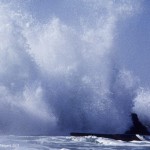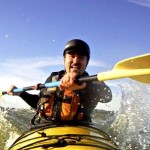
With a huge low pressure system sitting off Australia’s east coast, temperatures plummeted, rain poured down and the ocean swell jacked up to a massive 6 metres. Daily weather warnings advised everyone to stay away from the water as the conditions reached seriously dangerous levels. Then after a week of horror conditions, the weather finally died away and returned Sydney to her usual sunny winter weather.
Three hardy Team Fat Paddlers geared up to see what remnants of the storm were left, arriving to Grotto Point as huge 2 metre rollers jacked up and crashed over the rocky point. We lined up to surf if but a messy southerly wind chopped up the face of the waves, and after buzzing around, decided there probably wasn’t much to be had.
Of course that didn’t stop Midshipman Mike Stelzer who’d not really enjoyed kayak surfing before, and clearly knew not what he was getting into! As he paddled into the break zone, a nice 5 footer rolled in behind picking him up, and I watched as his mad paddling pushed him over the lip before he surfed wildly down the face, his trademark grin from ear to ear.
Of course, I had a funny feeling of what was to come, and Mike didn’t let me down. I watched as his boat started to broach, twisting to the right to take a new route towards the rocks of the point. As Mike tried desperately to keep the boat straight, the curling wave broke into his face and suddenly he was flipped upside down and tumbled into the froth.
Once I stopped laughing, I knew I’d better go in and help. I raced into the break zone and pushed his boat out of the path of the breakers before towing Mike, by now holding onto my stern, out of the wave zone and into Middle Harbour. Once there, we emptied his boat and performed an assisted rescue to get Mike back in, but one of his rudder cables had come loose and he needed urgent repairs, so we took off for a beach a little further into Hunters Bay.
This bay has some interesting rock formations that never see swell, so I moved in quickly to run a small gauntlet. But the big storm swell was still making its way into this part of Middle Harbour, and I was hit broadside by a wave that suddenly reared up and broke as it hit shallow water. I dropped my shoulder and let the wave pick me up and smash me arse-first into the cliff, before rolling down the cliff face and into the water head first.
Fortunately I managed to roll straight back up and after bracing agains the rock face as the next wave rolled in, I was able to paddle out of the little gauntlet to join the others at the nearby beach. Of course I also managed to get hit broadside as I came into the beach and again got to practice my side surfing, before being deposited up on the beach.
Even funnier of course was launching back into the waves, as the beach formation had created a nice wave convergence that made what would be an easy surf take-over quite difficult. We managed to get back out and took off to another point where the surf was surging through some rocks and create nice small rideable waves. We all spent some time catching waves before Mike was finally tipped out of his kayak (again), marking the right time for us all to head home.
We all had a great day surfing and playing today, but there were also a few spills and it was a good reminder on how important it is to paddle with friends. Mike’s first surf could have been a disaster without mates to quickly tow him out of danger – but then that’s what Team Fat Paddler is about – fun (and safety) with friends. I for one can’t wait to do it again, although maybe next time in my new boat! Cheers – FP
As I’ve found myself drawn to dynamic ocean whitewater, my boat needs have started to change as my paddling shifts from medium distance exploration to short bursts of speed and adrenalin in amongst the surf and rocks. My current tupperware sea kayak is quite good for the rough stuff but at 18 feet, is too long to manoeuvre in close to rocks. Its hull design also makes it a tad tippy when you catch paddles or parts of the hull on submerged rocks.
So I’ve spent the last 6 months considering many different boat designs and options. In the sea kayak realm there are a few boats designed for surfing and rock gardening, such as the poly P&H Delphin, which comes in at 15 feet and has a unique hull design especially for surfing, or the Sterling Reflection, with a hull designed to surf equally well backwards as forwards. And let’s not forget the Tsunami X15 as paddled by the Tsunami Rangers, with a length of 14 feet and a wash-deck for easy dismounts and remounts.
My general needs are basic, I want a boat that is short, turns easily, is tough, surfs well in any direction and has a good level of stability in the rough stuff. Of course my hefty weight (approx 290lbs/130kgs) is a limiting factor, with very few boats designed for that level of, err, paddler load, especially as the length of the boat decreases. With this in mind, I’ve sought out a range of advice from paddlers and suppliers experienced in ocean whitewater about various kayak designs that don’t fit into the mould, including surf kayaks, whitewater creekers and surf sit-on-tops.
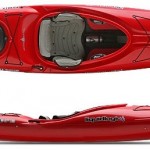
The culmination of my research has arrived at one boat – the Liquidlogic Remix XP10. This ten foot hybrid with a whitewater pedigree has plenty of volume for large paddlers, a rear hatch with enough storage to go camping, and enough length to generate good speed on waves. It has a spring-loaded skeg to help it track when cruising, and all the outfitting expected of a top-quality whitewater boat.
With thanks to Melbourne paddling superstore Capacity Sports, I’ve been able to order in an XP10 which should arrive any day. I can’t wait to add this great looking boat to my fleet and am looking forward to learning all about her in some rough stuff soon. Expect to see lots of photos and video in the coming months as I see what she can do, but in the meantime check out this little teaser below to see the kind of water these boats are designed to play in. Cheers – FP
Tags: Capacity Sports, Capacity Sports Melbourne, Liquidlogic, Liquidlogic Remix XP10, Remix, Remix XP10

Eric Soares meets a 4m wall of water. Photo by Jim Kakuk, who was reportedly HAMMERED by this wave a second after this shot was taken! Used with permission, copyright Tsunami Rangers 2011
The Tsunami Rangers are well know for their crazy antics in big surf, wild rock gardens and surfing in caves. This band of renegade paddlers spent many a year playing along the west coast of the US and become renown for smashing boats and big wave surfing. I have an inclination towards coastal exploration (a diplomatic way of saying rubbing my kayak up against rocks and cliffs in frothy water), but there are few mentors in my neck of the woods with any real experience in this type of playful (and sometimes painful!) style of paddling.
Recently Team Fat Paddler had the pleasure of hosting the Tsunami Rangers’ very own Captain Kuk, who on a sunny Sydney morning shared his experience and skills with us as we worked the waves (and for Gelo, the cliffs!) of our local rock gardens. The experience left us enthralled with the possibilities, but his departure left us with both a taste of the possibilities and a distinct lack of mentors here who could help us continue to develop.
The other Team Fat Paddler rock-lovers are, like myself, complete beginners in this area. Between us we have many questions on both rock gardening and surfing so I decided to approach another Tsunami Ranger, Commander Eric Soares, and asked if he’d be willing to share his knowledge with some antipodean rock-gardening wannabes. I’m humbled to say he was generous in his answers and willingness to share – I hope you enjoy our interview.
FP: Eric, thanks kindly for taking the time to help some beginners on the other side of the Pacific. Our questions are really on two areas of interest for us, namely kayak surfing and playing amongst the rocks. Firstly, some people who have watched video footage of the Tsunami Rangers think we are mad for wanting to do this at all. Are we a few cans short of a six-pack to want to do this in the first place?
Eric: Why yes, you are. But since you’ve taken the plunge, I say go for it. If you don’t have a mentor around, you can teach yourselves. Just slow down, check everything out each time, and then go for it boldly. Later that evening, as you catch up on the six-pack, debrief and share what you learned. Vow to improve.
FP: Ok, so lets put our sanity aside for a second and discuss surfing first up. You wrote a great post recently on entering the surf and playing around in the soup. For us beginners who, errr, aren’t exactly good rollers, this seems a little scary. Is it an absolute necessity to be able to roll before attempting to play in waves?
Eric: Yes. If you can’t roll, you can’t brace properly and will thus be afraid to fully commit. If you don’t commit, you’ll never be able to surf anything except a little mushball of a wave. Try really hard to learn to roll. In the long swim (ahem), it will be worth it.
FP: Clearly, being able to swim is a pre-requisite. But what about safety equipment, what type of gear should we invest in to ensure we can play another day?
Eric: Good helmets, of course, to protect your “short of a six-pack” brain. Well-fitting PFDs, to protect your thorax a bit. And good shoes (we use neoprene booties, but those might be too hot in Oz) so you can walk on coral, rocks and urchins. Oh yes, and skin covering. In California and Oregon, that’s a full wetsuit; in Oz, that’s Lycra.
FP: Many paddlers down here started as surfers and have a good general sense of surf awareness, understanding of rips and currents etc. Are there other facets of the surf zone that kayakers need to pay particular attention to?
Eric: Nope. Except breaking waves of course. And rocks. Rebar is also bad. Sewage outlets….
FP: For surfing specifically, what should we look for in a kayak? What design aspects make a good surf kayak?
Eric: Any boat will do. I wouldn’t use your brand new graphite baidarka (too precious) or a fat tub boat (not responsive and hard to roll). River kayaks are good, and sea kayak with rocker works well. Then there are specialized surf kayaks, surf shoes, wave skis, short SOTs, and the like–all very good. Boats made of Kevlar or rotomolded plastic will break less often. But all boats can break in surf and rocks….
FP: What about boats for rock gardening – what design aspects help when playing in the froth and tight spaces of a rock garden? And what modern boats are available now that are suitable (since not many of us can get our hands on a Tsunami X15!)?
Eric: Reread my last answer. If you can’t get a Tsunami X15, then I’d say get a boat with rocker. A river kayak is good. Even a cheapo sit-on-top is fine, as long as it is maneuverable.
FP: Ok, let’s move onto rock gardening. For beginners who want to play amongst the rocks, what particular skills should we focus on acquiring first up?
Eric: Rough-water swimming, rescues of all types, rolling, and surfing.
FP: Inevitably, we’re going to fall out of our boats in the rock zone. What is the best approach to get out safely when ripped out of your boat in amongst the rocks?
Eric: Get out quickly! If you have a SOT (sit-on-top) such as the X-15, just jump back aboard and paddle back out fast. If you have a sit-inside kayak, decide quickly to either re-enter & roll and then get outside or swim your boat out. If you really mess up, go into shore or climb high onto a rock and consider your options. The most important thing is never let your body take a beating on the rocks. This is a complex subject. I deal with this issue in one of my blog posts (http://tsunamirangers.com/2011/04/11/between-a-rock-and-a-hard-wave/). Check this out and read all the comments.
FP: There’s some strong opinions on the type of paddles best suited to this type of paddling, with many frowning on my use of a Greenland paddle in the froth. What do you prefer to use and am I an idiot for sticking with my GP?
Eric: Your GP is fine. I’d recommend a GP (or any paddle) with reinforced tips, so it has less chance to break. Graphite is no good. I use a Merv Larson surf paddle made of compressed Kevlar. I’m learning to use a GP and have even used a canoe paddle. My current GP is too delicate (light cedar), so I’m hankerin’ for one with reinforced tips. Bottom line: other than graphite, any paddle which the boater can use easily and roll with is fine.
FP: Eric, it’s been a real pleasure to get your insights on this. Do you have any final advice for those of us who want to give this type of dynamic paddling a go?
Eric: Yes. Read books and watch videos on kayak surfing to keep you motivated and to fill in knowledge holes. If you can find mentors to help you, provide them with lots of beer from your dwindling six-pack, and feed them sausages from the barbie. Seafood is good. If you can’t get a mentor, take a clinic or two from someone reputable (recommended by people you trust). Of course, experience is your best teacher, so boogie out to the surf and Ride the Grooveline!
FP: Commander Eric Soares, Tsunami Rangers. Thank you kindly for your time.
Note: Eric and fellow Tsunami Ranger John Lull have just posted an excellent article on exiting the surf, an area I hadn’t even thought to touch on! Read their excellent article here.
Tags: Eric Soares, kayak surfing, rock gardening, Tsunami Rangers
At the beginning of the year I was lucky enough to travel to Canada where I picked up a number of canoe paddles from the man who makes them himself, Mike Ramsey of Badger Paddles. In my package were four paddles – a custom Sliver in cherry, a custom Tripper in cherry and two small Cub paddles with my daughters names painted on them.
I’ve used them now a fair bit over the past few months but decided to spend a full session on the water really playing with them. I pushed off in my Wenonah Encounter solo canoe at Berowra Waters at 5.30am, in the darkness and with the thermometer recording -1C degrees! The goal was to power up into the Berowra Gorge ahead of the dropping tide, before turning around for a leisurely cruise back, with a planned stop at my favourite hidden rock pool.
For the run upstream against the tide, I settled in with the Tripper. It’s a beautiful paddle that bites the water well giving a good sense of power, but with its tapering end still feels smooth in the water and gentle on the shoulder. I found I could really get the Encounter up to a fair speed with it, pushing lots of water as well as giving me lots of steering control on the J-stroke. The cherry is a stunning timber but does make the paddle a touch heavier than some of my other canoe paddles, but then I did ask for them to be made strong. The grip is comfortable in the hand and gives plenty of control. The only area I found the paddle to struggle with was during the recovery stage of an Indian-stroke, where I found the shape of the paddle made controlling it through the water difficult.
Once I arrived as far upstream as I could get I turned for the leisurely cruise back downstream, switching to the Badger Sliver. The shape of this paddle is magnificent, with each stroke being virtually effortless. It has the same grip as the Tripper and is similar in many ways, except that the slender shape makes Indian-strokes incredibly easy, so much so that I found myself using an Indian-stroke for many kilometres as I enjoyed the beauty of the gorge around me. The paddle definitely lacks the bite of the Tripper and pushes far less water, but its ease of use and the smooth slide through the water make it incredibly attractive for cruising. And lets face it, not all canoeing is about pushing your boat hard, many of us prefer the slow explore and cruise, which this paddle is absolutely perfect for.
The Badger Cub paddles are clearly not designed for big fat men such as myself, but they are beautiful, bright and light (and my daughters absolutely love them). The small size makes it easy for little hands to use and the range of colours draw children to want to use them. Having your children’s names painted on the paddles is an extra touch that the kids love, and also serves to reduce the chance of ownership disputes!
The last item I’ve been using lots this year is the Badger Paddle Sock. This is a stretchy cover for your paddles which is easy to slip on, easy to secure and looks really classy.
Conveniently the stretchiness means it will fit a range of different paddle shapes and sizes – I’ve had bent shaft marathon paddles in them, I’ve had my Badgers in them, and I’ve even had whitewater split kayak paddles in them! They will shape to almost any paddle you can think of, meaning you can re-use them for whatever flavour of paddling you want to do on any given day.
The Badger Paddles “company” is a family run business that is immersed in canoe-culture and adds a little of their paddling passion to every product, which is clearly demonstrated in the form, finish and overall beauty of their paddles. Mike and Fiona love their business and are always happy to offer loads of advice and insight into the world of canoeing, and you get the feeling that every customer ends up becoming a friend. But regardless of all that, if you get your hands on a Badger Paddle you will most likely love it for a very long time to come. Cheers – FP
Tags: Badger Cub, Badger Paddle Sock, Badger Paddlers, Badger Sliver, Badger Tripper, Reviews
Some time back I met a great couple of Aussie canoe fans online and hooked up for a paddle on the flooded Colo River (where we were involved in a horse rescue). These boys love their canoes, and whitewater in particular, spending much of their time hunting whitewater runs through the hills and mountains surrounding Sydney.
Today I heard from them again where they shared another of their videos, this time practicing their whitewater skills in the surf! They’ve kindly let me share their video with you, proving that there’s more than one way to surf a wave.
Make sure you check the images below for some bonus footage that didn’t make it into this little clip. What a great way to have some watery fun!! Cheers boys – FP
Tags: canoe surfing, ocean whitewater