Welcome to the first guest review on FatPaddler.com! Team Fat Paddler Sub Lieutenant Nat Bradford is a recent convert to the ocean-ski genre and is enjoying immersing himself in the new world of paddling that is opening up for him.
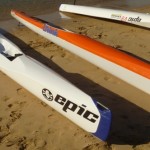
[Author: Nat Bradford] Being very new to the whole surf ski caper, my introduction to the water on the Epic V8 has been a great experience. The boat is stable – really stable. My first test runs on various skis involved me under them more than on them, but with the Epic V8 I was able to get underway and stay upright without needing to resort to major pilates-style core strength and balancing exercises.
So after six months of trial and error, and a life changing lesson from Jim Walker (thanks again for making me paddle with you and the tinny attached to the front of the ski, Jimmy), I’ve now completed a few races and countless acts of lunacy with Capt FP and have become a very low skilled surf skier (see what happened prior to my lesson, below).
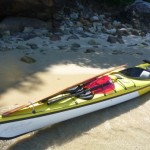
I’ve become very comfortable with my Epic V8, but the recent arrival of the stunning looking entry-level ski/kayak hybrid, the Think Fit, had me intrigued. On first impressions it looks as though someone had stuck the front of a Think Evo to the back of a sea kayak and just blended them together. That’s not to say it doesn’t look good, it’s just hard to get your head around. Further cross-dressing comes in the form of a raised seat within an enclosed cockpit, a-la sea kayak, but with ski-style rudder pedals. It also has the option for a kayak skirt, and a small day hatch behind the seat that could prove useful on long hauls.
Without too much thought, I jumped in and set out from Sydney Harbour Kayaks on a quick shake down paddle. I’d initially left the pedal length too short, but wanted to see just how tippy the Fit felt in comparison to the Epic, and with my knees in my chest this wasn’t going to be a hard task. I was surprised by just how far you could tip without falling out, but suspect if this was the first boat I’d ever paddled, I may not share that sentiment. My other impression, possibly because of its roughly 2kg weight advantage over the V8, was that it was faster from a standing start to top speed (at least the top speed I could manage). This was after adjusting the pedal length, which was a little trickier than expected due to the screw in mounts versus the quick release plugs on the V8. And one major plus on the side of the V8 – a ruler next to the pedal adjustment/heel mounts makes for matching both sides up just that little bit easier – the simplest ideas are often the best.
But if I’ve learnt one thing from my short time in skis, the one who spends the most time on top of the ski is going to have the most fun. Through necessity, I’m now very proficient at self-rescue so when the inevitable spill happened, I backed myself to be back in the Think in no time. However, the design differences between the Epic and the Think become very apparent at this point, as I drifted into The Spit channel after attempting and failing to re-enter the Fit about half a dozen times – on the one hand I’m glad no one saw me flailing about, but on the other hand I’m not sure anyone was coming to help if I got really stuck. It seems to be a much less forgiving boat to get back into and I imagine this will deter newbies keen to learn the ropes. It’s not that the basic re-entry technique needs to change much, but the action of having to swing your legs into an enclosed foot well is a whole different skill that I’m sure our sea kayak friends know well, but one I’d guess most skiers just aren’t that used to.
Back on dry land, I had a chat with SHK’s Candice who’s running paddle fitness training sessions with both the V8 and the Fit – she also thought the Fit was likely to be tippier for a beginner, but that its weight advantage might be better for lighter paddlers and women (ie not someone wearing a TFP t-shirt, for example). We both agreed it was hard to be too critical though given its potential speed benefits, and that neither of us had tested it in swell or surf (NB: this is me comparing notes with a world-class iron woman – which would be like me comparing my low-grade suburban rugby career with that of Wallabies captain Rocky Elsom).
I’ll reserve my judgement on the Think Fit until the lads at Think can arrange an open ocean demo at some stage – it’ll be good to have the help around when I need to get back into it! There’s a lot to like – speed, lightness, good looks, but I think I’ve got that already… with my Epic V8, that is.
Of course, if you’ve never been in a ski before and are keen to join the ever growing legion, give both boats a try – one thing is for certain: when you’re done, you’ll buy one of them!
[FPs Note: A warm thanks to Nat for penning this opinion piece on these entrant boats for the growing sport of ocean skis. And I'd like to especially thank him for that entertaining impersonation of a submarine - haha!]
Tags: epic v8, Kayak Review, Nat Bradford, ocean ski, Think Fit
SHK‘s latest shipment of boats arrived this week and I was itching to get down to see the newly arrived range of Boréal Design and Maelstromkayak boats. In particular I was interested in the Vaag, a saucy playboat designed by mad tide-racers our of Quebec, Canada.
Sol and I carried the Vaag down the water’s edge where I could get a good look at her sleek lines. Her design deviates from many of the sea kayaks out there, and I was interested to see what those differences looked like. The first thing I noticed was her cockpit, which has an extended keyhole, a shaped foam cushion and a sloping bulkhead behind the seat with a thick pad on it.
The extended keyhole cockpit is great – I thought it would be hard to get into, but in fact this is the first boat I’ve tried where I could sit in the cockpit first and bring my legs in behind me. For this I was extremely impressed.
The close bulkhead is great for emptying water out (which I found out later!!) and the design allows Greenland-style paddlers to easily lay back on the rear deck. When paddling I found the seat snug, well-fitting and extremely comfortable, so I was pretty happy with that. The skeg slider is mounted at hip-level next to the cockpit and is incredibly smooth to operate – far easier and smoother than my own kayak.
The front deck is low and has a hatch for small items. The rear day hatch is different from most other sea kayak set-ups in that it is centred rather than offset to one side. I initially thought this would be a bit of a problem, but in fact it was easy and accessible to get into, and even easier to close than the off-set types, since you can just lean your weight back onto it without upsetting the balance of the boat.
Lastly, I noted that the Vaag has an interesting hull shape, quite different from the moderate V hull of my British sea kayak. The hull is quite flat with a distinct curved chine, which looked like it would be sensational surfing down the face of a wave (or I suppose tide-race, if we had any!).
I couldn’t wait to get into her and head out into Middle Harbour. The only problem was there was an enormous North-Easterly blowing which was making kayaking extremely difficult, with confused chop mixing with boat wake to create some nasty patches out in the channel. I started using my GP and found the boat to be extremely twitchy in the confused water, making me hesitant to edge it too far in case I fell into the drink. The Vaag tracks straight as an arrow however, and without plenty of edge can be pretty difficult to turn, especially in strong quartering winds.
With the twitchiness in the winds making me nervous, I swapped over to my H2O Crystal-X Euro paddle to see if it helped me with bracing. This enabled me to get plenty of speed which helped bed the Vaag down into the water, gaining stability as well as plenty of steam to get on waves. In fact, with the flat bottom of the boat I’d find even the slightest wave behind me would pick the boat up and throw it down its face. Simply, this thing surfs like you wouldn’t believe!
However, despite the power the Euro provides, I was still feeling less comfortable than I had with my Adanac GP. I decided to get out of the wind, find a little beach to pull into, and swap my paddle over. Then as I cruised towards the shoreline, out of nowhere the boat suddenly tipped me out!
Funnily enough I didn’t even realise my GoPro camera was running, but it certainly gave me a laugh later when I noticed how good my underwater hat retrieval skills were – haha!
Anyway, I got the Vaag into the beach and emptied the water out of the cockpit (made very easy by the rear sloping bulhead) before swapping my paddles over for the return leg. Then I was back out amongst the wind again, bouncing around in the waves but enjoying the great speed the kayak is capable of – even with my stick.
The Verdict
The Maelstrom Vaag is a beautiful performance kayak designed for play. For someone of my size (127kg/280lbs) I found the boat a touch small, especially around the legs due to the low front deck. This also means it has a lower volume and I dare say I was sitting pretty low in the water – in fact on many occassions where I had a little edge going I found my paddle hand immersed in water.
The boat tracks incredibly well but does need to be pushed right onto edge to turn, making it best left to more experienced paddlers. It felt very twitchy to me in the strong winds, but a lighter paddler with more experience in narrow boats such as Nordkapps or Nadgees would not find this a problem. On waves the Vaag takes off, and for the coastal surfers this boat would be an absolute blast.
The fit out is excellent and I particularly liked the entire cockpit design. The keyhole makes entry/exit a breeze (yes, even wet-exits – haha!), the seat is very firm and comfortable, and I loved the sloping back bulkhead with padding which makes laying back on the deck a breeze (although paddlers who prefer back-bands on their seats may not agree). The skeg control is out of the way and I didnt once knock it with my knuckles, something I seem to do regularly with my Brit skeg boat.
I liked the day-hatch set-up although I’ve heard a few people say they don’t like its position. I dare say if the knockers were shown how easy it is to use they may change their tune. Lastly, the Vaag comes with a paddle loop on its nose which seems made for slipping your Greenland paddle into – a feature which for obvious reasons gets top marks from me!
I’m going to try a few more test paddles in this boat in varying conditions to see if the twitchiness improves as I get used to her. With a little more stability I think I could fall in love with this playful design – time will tell. Cheers – FP
Tags: Kayak Review, Maelstrom Kayaks, Maelstrom Vaag, Reviews

Nadgee Solo Kayak
I dropped into Sydney Harbour Kayaks for a trial of the new Nadgee Solo composite sea kayak that they recently added to their stock. The Nadgee is a beautiful, locally-made composite expedition kayak designed for hard-core sea paddlers. I was actually a little hesitant to get in for the test run!
The first thing that was quite apparent is that I was simply too big for it. Squished into its cockpit, I looked on the water suspiciously like a paddling muffin – way too much overhang for anyone’s viewing pleasure. The seat itself is carved foam and felt quite comfortable, but in terms of leg room and cockpit size, I was wedged in tighter than a fishies’ bottom!
On the water the Nadgee paddles beautifully. I quickly picked up speed and noticed that even under my considerable weight, there was hardly a ripple from the bow as it cut smoothly through the water. With a bit of a V-bottom on it, the boat is a little bit twitchy, which would no doubt work well in big ocean waters. On the flat waters of early morning Sydney Harbour however, I found myself getting the occasional speed-wobbles as I tried to keep it upright.
As the morning progressed I took the Nadgee into some small ocean swell coming through the Heads into Balmoral, but found my lack of core balance with the boat made the ride pretty scary. So I decided to head up into Middle Harbour instead, where the conditions would be a little bit calmer (or so I thought).
What I wasn’t aware of was the building 25-30 knot southerly wind which was throwing up following wind waves behind me. Again this made the paddling quite challenging, until I turned around and paddled back into the wind for the trip back to the The Spit.
In summary, the Nadgee is a truly beautiful well-designed and well-built sea kayak ideal for intermediate to advanced paddlers. It is not for beginners, as it’s twitchiness would have many novice paddlers spending much of their paddling time swimming instead. Likewise, I would not recommend this boat for the bigger man – after 2 hours in the kayak paddling I was suffering from pretty bad cramps. But for more reasonably sized experienced paddlers I can see why the boat is so highly rated – it is fast, fun and a very serious kayak for ocean paddlers.
Tags: Kayak Review, Nadgee Kayaks, nadgee solo, sea kayaks

Epsilon P300 - a damn sexy kayak
My good friends at Sydney Harbour Kayaks let me know that the latest container-load of kayaks had arrived from Boréal Design, and that I should try out the newly-designed Epsilon kayak series*. This interesting series has been designed as one kayak idea in a range of configurations to fit everyone. They come in either plastic or composite, and come in three sizes scaled to the size of the paddler. But in all other facets, they are basically the same kayak. Brilliant!

Epsilon P300 sea kayak: low profile rear deck perfect for eskimo rolls
Being a big fella, I chose the biggest of the plastic Epsilons, the P300. With a roomy cockpit I had no problems getting in and my XL Boréal Design sprayskirt (which I use on my big volume BD Nanook) fit the cockpit perfectly. With a quick seal-launch onto Sydney Harbour, I was away.

Epsilon P300 deck configuration - day hatch & spare paddle bungees
Immediately I noticed the incredible fit. My thighs fit perfectly into what felt like custom-made channels in the cockpit, comfortably braced by thigh pads. The fit was so good I felt like the kayak had been made precisely to fit, and the control this natural brace position offered over the kayak was a true pleasure. If there was only one key point to make about this kayak it would be this point – the fit, and bracing, are sensational, especially for a big-thighed bloke like myself.

Epsilon P300 kayak - beautiful lines
Once in, I head off quickly for my local rock garden. With so much control, and a strong plastic hull, this baby seemed perfect for a bit of close fun in the rocks and waves. So once at the point off Chinamans Beach, I pushed her through her paces by zooming in and out of the rocks as ocean swell rolled throught the rock formations. Now I was seriously starting to have some fun!

Epsilon P300 - Rock Garden Pt1 - Incoming surge

Epsilon P300 - Rock Garden Pt2 - Draining water and lumpy turbulence

Epsilon P300 - Rock Garden Pt3 - Bubbling turbulence, woohoo!
These are the closest photos I have to show the fun I was having (considering I was bobbing about in the rock-zone holding a camera in one hand and my paddle in the other!). When not taking photos, I was zooming back and forth in the rushing swell laughing my head off at the fun I was having.
Then I decided to head away from the rocks and towards the sea, throwing the Epsilon over both ocean swell and boat wakes and plunging her nose-first into other on-coming waves. No problems here either, the water rushing over the bow would sweep away to the sides and barely looked like it would get close to the cockpit.

Epsilon P300 - Plunging the nose into waves, just for fun!
With the waves behind me it was even more fun – the Epsilon launched itself down the face of waves, surfing easily and maintaining a good track with it’s flip-down rudder. After catching a few waves through some more rock formations, it was time to return the kayak to its Sydney Harbour Kayaks home.

Epsilon P300 - A relaxing paddle amongst the yachts to finish up
My final verdict is, frankly, embarrassing. I was gushing over this kayak. The incredible fit, the control, the performance amongst the waves & rocks and the well designed deck configuration all make this plastic sea kayak a fantastic fun boat. I’ve yet to try the composite version as a comparison, but I have a funny feeling I’m going to like the plastic version better anyway, especially as I find myself drawn more and more to the buzz of rock gardening. The low profile back is going to make this a great eskimo rolling boat and with that skill firmly in my sights for this summer, I can’t help but think this would be great kayak to add to my collection (note: adding more kayaks to my garage will unfortunately lead to severe marital conflict!).
Brilliant stuff Boréal Design, absolutely love it!
*Epsilon kayaks now available in Australia from Sydney Harbour Kayaks, The Spit, Sydney.
Tags: Epsilon, Epsilon C300, Epsilon P100, Epsilon P200, Epsilon P300, Kayak Review, Sydney Harbour Kayaks

Shrike B450 plastic sea & surf kayak
My friends at Sydney Harbour Kayaks have introduced a new brand of kayaks, Shrike, to their already impressive quiver of paddle-craft. After being talked up as incredibly high-quality hand-made boats I asked to take one for a test paddle, and in blasting 30 knot winds and armed with my greenland paddle, out I went.
First impressions – the boat was pretty difficult to get into for a big fella like myself, and it took a bit of effort to squeeze myself into the cockpit. This is a common issue for me, and for someone a bit lighter I can’t imagine this would be much of an problem.
Stability in the boat is pretty good considering it has such a streamlined shape, and I was impressed at how much lean I could push into her without tipping myself into the drink.

Shrike B450 - clean sweeping lines, light-weight plastics
The speed for a plastic kayak is excellent. Paddling alongside Shannon from Sydney Harbour Kayaks, who was paddling a composite Boréal Design kayak, and even with my greenland paddle he was struggling to keep up with me. For a plastic kayak, the speed is really very impressive, and enabled by both its streamlined shape and its incredible lightness (enabled, Shannon tells me, but an innovative construction technique keeping the weight down to a measley 22kg – astounding!). Its nicely finished off with hatch-covers made from 100% recycled plastic, a plus for those of us with a slight green leaning.
The rudder system is an innovative sprung-sling system than needs to be seen to be understood, and is quite an innovation in terms of rudder storage design. In terms of steering though, I found it a little soft, but the Shrike B450 is incredibly manouverable without the rudder, and I found myself easily throwing the boat around with edging and paddle strokes.

The Shrike B450 classic kayaker's bow shot
In terms of general feel, this is a really fun boat. I bounced her around some big swell and boat wake and found her really easy to handle. Her manouverability makes this boat ideal for rock-gardening, and if it wasn’t the demo stock I would have loved to have bounced her off some rocks in the surf! This is a undoubtedly a close-shore specialist and if it came in a bigger size I’d love to have one for surfing, exploring and general fun amongst the rocks. A great addition to the SHK range – thanks for the test paddle!
Tags: kayak, Kayak Review, kayaks, shrike, shrike A490, shrike B450, shrike kayaks